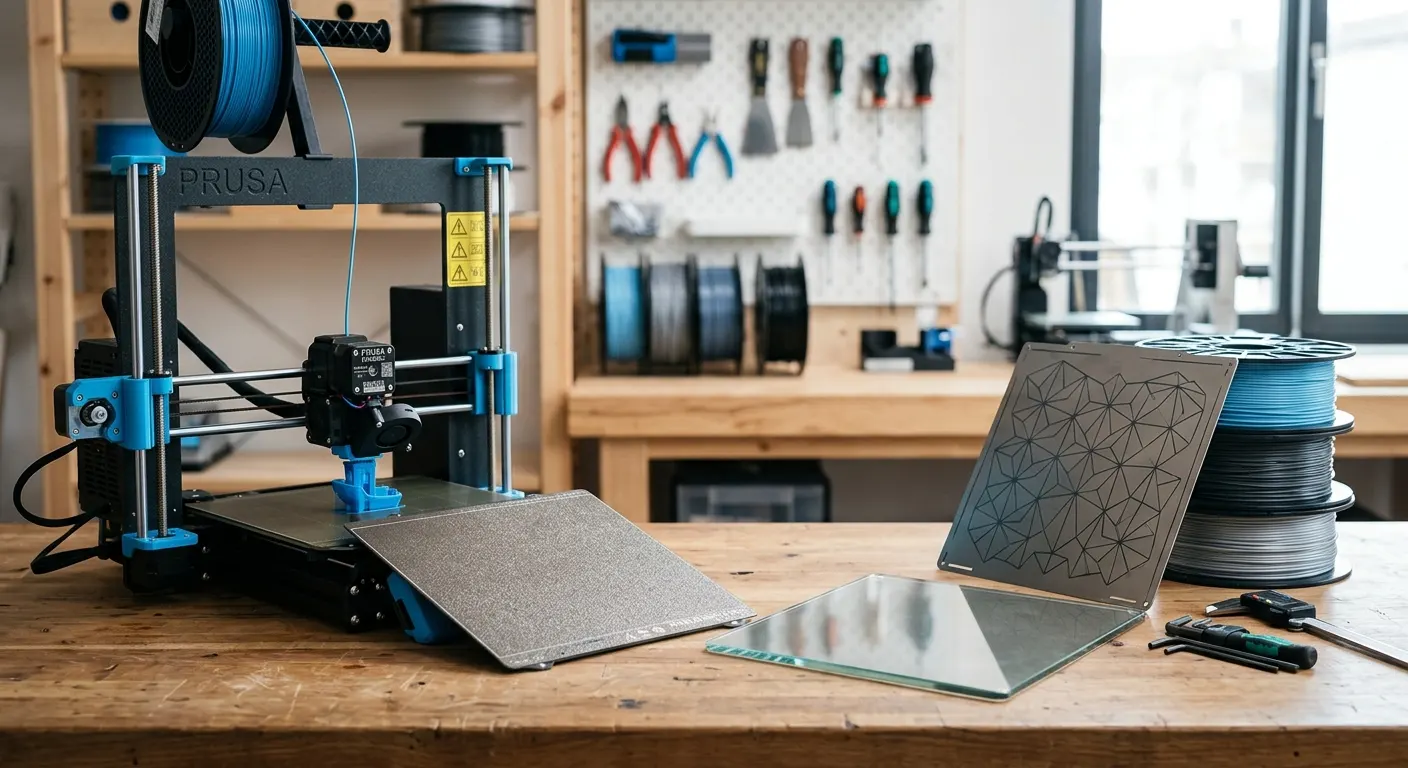
The build plate is responsible for two opposing requirements in a single print session: gripping the part firmly enough that it does not warp or detach while printing, then releasing it cleanly after the print cools without requiring force that would damage the part or the surface. Different materials require different adhesion chemistry. PLA on smooth PEI at 60 degrees Celsius grips well and releases clean; PETG on the same surface at 70 degrees can bond so aggressively it tears chunks of PEI off with the print. The right build plate choice depends primarily on the materials you print most frequently, and secondarily on your printer platform.
Quick answer
PEI spring steel is the right surface for most FDM users: it grips PLA, PETG, ABS, and ASA and flexes to release on cooling. Use textured PEI for easy PETG and TPU release, smooth PEI for glossy PLA bottoms, and G10 Garolite for nylon, which PEI cannot grip. Add Magigoo as a release agent for aggressive PETG.
This guide contains affiliate links. LayerGrade may earn a commission at no cost to you.
PEI spring steel: the correct choice for most FDM users
PEI spring steel sheets are the dominant build surface in consumer FDM printing for practical reasons. PEI is chemically compatible with PLA, PETG, ABS, and ASA at standard bed temperatures. The spring steel substrate flexes on cooling, creating mechanical force that breaks the adhesion bond without requiring the user to apply force to the part. The flexible magnetic mounting system makes plate swapping a five-second operation.
For Bambu Lab printers, the Bambu Lab Textured PEI Plate is the purpose-designed option that uses Bambu's validated coating chemistry and matches the printer's calibration defaults. For Ender 3, Prusa MK3S and MK4, Prusa MINI, and similar open-market FDM printers, the Wham Bam PEI Spring Steel Sheet is the highest-durability third-party spring steel PEI solution available in all common bed sizes.
Budget-conscious Ender 3 users looking for the lowest-cost PEI upgrade should consider the Energetic Smooth PEI Magnetic Sheet , which provides adequate PLA and PETG adhesion at a significantly lower price than Wham Bam. The Energetic sheet has shorter coating lifespan than Wham Bam, but at the price difference, replacement is straightforward.
Smooth PEI vs textured PEI: which surface for which material
Smooth PEI provides the highest first-layer adhesion for PLA and produces a smooth, slightly glossy bottom surface on printed parts. It is the correct choice for prints where bottom surface appearance matters and for small parts where high adhesion reduces warping risk.
Textured PEI provides slightly lower adhesion for PLA but handles PETG and TPU more reliably without over-adhesion. The micro-texture surface imprints a matte finish onto the first layer that conceals any adhesion artifacts and is popular for display pieces. Both the Bambu Lab Textured PEI Plate and the Wham Bam PEI Spring Steel Sheet are available in textured versions.
PETG is the material where build plate choice most directly affects print quality. On smooth PEI, PETG can adhere so strongly at 70 to 80 degrees bed temperature that removing the print risks delaminating the PEI coating. Solutions: use a thin layer of Magigoo 3D Printer Bed Adhesion Stick as a release agent on smooth PEI for PETG, or use textured PEI which provides lower but adequate adhesion for most PETG prints.
G10 Garolite: the nylon printing solution
PEI surfaces do not provide adequate first-layer adhesion for nylon (PA-6, PA-12) and PA-CF filaments. Nylon requires a surface that provides both mechanical and chemical grip that holds at the high bed temperatures nylon requires (80 to 110 degrees Celsius). The G10 Garolite Build Plate is the specialist solution that experienced nylon printers use exclusively.
Nylon bonds to Garolite at print temperature and releases cleanly when cooled below 40 degrees Celsius. The mechanism is primarily mechanical adhesion, the Garolite surface texture provides a grip matrix that nylon wets into when hot. Unlike PEI which relies on chemical adhesion, G10 works through a physical mechanism that suits nylon's surface chemistry.
G10 Garolite is a single-material specialist surface, it provides no benefit for PLA, PETG, or ABS, and should be treated as a dedicated nylon surface alongside PEI for standard materials. If you are printing nylon regularly, keep a G10 sheet cut to your bed size and swap surfaces when changing material type.
Bed adhesion aids: when to use them and which to choose
Bed adhesion aids are the bridge solution for materials that require more than the build surface provides alone. ABS warps aggressively on any surface without an enclosure and benefits from adhesion spray even on PEI. PETG on smooth PEI benefits from a release agent. Nylon on surfaces other than G10 requires adhesion assistance.
Magigoo 3D Printer Bed Adhesion Stick is the purpose-formulated option for 3D printing. Unlike hairspray or generic glue sticks, Magigoo is designed for the specific temperature and adhesion requirements of FDM printing. The hot-grip, cold-release behavior is tuned for printing temperature ranges, making part release straightforward even for ABS without requiring the heated bed to cool fully.
For users who want the simplest possible adhesion aid, the Elmer's washable glue stick, a standard option in the 3D printing community, provides adequate adhesion assistance for most materials at a cost of under $5. It lacks the precision of Magigoo 3D Printer Bed Adhesion Stick but works for occasional use on materials that just need a bit more grip than clean PEI provides.
Maintenance: keeping your build surface in condition
The most important build surface maintenance habit is cleaning with Amazon Basics Isopropyl Alcohol 99% before every print. Skin oils transferred from handling the build plate degrade first-layer adhesion immediately. A few milliliters of 99% IPA on a lint-free cloth removes residue that lower-concentration IPA leaves behind.
PEI surfaces eventually need replacement after 300 to 500 print cycles as the coating degrades. Signs of degradation: first-layer adhesion becomes inconsistent across different areas of the plate, or adhesion is adequate only at the center where the plate is hottest. At this stage, replacing the sheet is more reliable than troubleshooting slicer settings to compensate for surface degradation.
Between prints, store flexible PEI sheets flat or on the printer's magnetic base. Do not stack flexible sheets without protection between them, the PEI coating on the bottom surface of one sheet will abrade the top surface of the sheet below.
FAQ
Frequently asked questions
Smooth or textured PEI: which is right for my materials?+
Smooth PEI gives the strongest grip and a glossy bottom surface, which suits PLA and small warp prone parts. Textured PEI grips slightly less but handles PETG and TPU more reliably and hides first layer flaws with a matte finish. If you print mostly PLA for looks, go smooth. If you mix in PETG and TPU, textured is the more forgiving everyday choice.
How do I keep PETG from ripping chunks out of my PEI plate?+
PETG bonds aggressively to smooth PEI at its higher bed temperatures and can delaminate the coating on removal. Use textured PEI for lower but adequate grip, or apply a thin release layer of glue stick or a purpose made adhesion product on smooth PEI. Always let the plate cool fully before flexing, since PETG releases best at room temperature.
What build plate do I need for nylon?+
PEI does not grip nylon well. G10 Garolite is the specialist surface that nylon and PA-CF bond to at print temperature and release from once cooled, usually without hairspray. It is a single purpose surface that does nothing for PLA or PETG, so keep a G10 sheet cut to your bed size and swap to PEI for everyday materials.