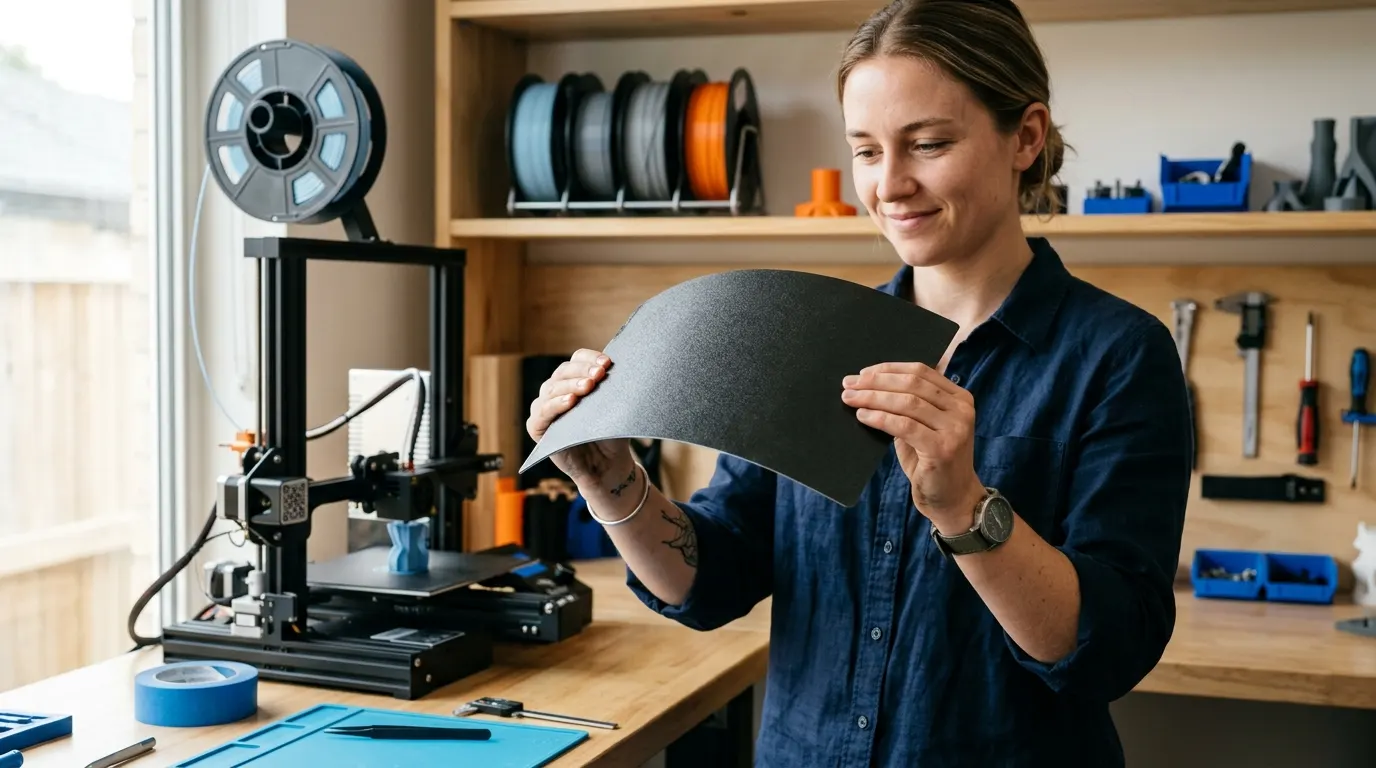
A build plate is responsible for two opposite tasks in a single print session: gripping plastic firmly enough to prevent warping and layer separation, then releasing the finished part cleanly after cooling. The surface coating is what makes this work, and different surfaces excel at different materials. PEI spring steel is the industry standard because it handles multiple materials reliably and flexes to release on cooling. Textured PEI adds grip and hides layer lines. Smooth PEI delivers glossy finishes. G10 Garolite is the specialist solution for nylon and engineered polymers where PEI cannot compete. This guide covers what makes each surface special, when to use it, and the maintenance routines that keep your plate printing reliably for hundreds of cycles.
Quick answer
For most FDM printing, PEI spring steel is the right choice: it grips PLA, PETG, and ABS reliably and flexes to release when cooled. Use textured PEI when you print PETG and TPU for easier release, smooth PEI when you want glossy finishes for display parts, and G10 Garolite exclusively for nylon and carbon fiber composites. Clean with Amazon Basics Isopropyl Alcohol 99% before every print.
This guide contains affiliate links. LayerGrade may earn a commission at no cost to you.
What makes a good build plate surface
A build plate surface must grip hot plastic firmly during extrusion, then release the cooled part without requiring force or damage to either the surface or the print. This dual requirement drives the choice of surface material. Pure adhesion alone is not enough, a surface that grips too aggressively is counterproductive if the part cannot be removed. The best surfaces achieve a balance where hot plastic bonds chemically or mechanically to the surface, then that bond weakens predictably as temperature drops.
PEI (polyetherimide) emerged as the dominant build plate coating because it handles this balance across multiple common materials. PLA, PETG, TPU, ABS, and ASA all bond to PEI at their respective bed temperatures through a combination of chemical adhesion and micro-texture interaction. The surface remains predictable after hundreds of print cycles as long as it is kept clean and stored correctly.
Spring steel backing is almost universal under PEI now because the flex of the metal sheet provides mechanical force to break the adhesion bond when the plate cools. A part printed on a spring steel PEI plate releases automatically or with a gentle flex of the sheet, the metal itself does the work rather than requiring the user to pry or apply force.
Spring steel with PEI: the industry standard
PEI spring steel sheets are the default build surface on nearly every modern FDM printer, either as the stock surface or as the first upgrade most users buy. The combination works because PEI provides chemical adhesion during printing and the spring steel substrate provides mechanical force to break that adhesion on cooling. For Bambu Lab users, the Bambu Lab Textured PEI Plate is the factory-validated option, tested and profiled in Bambu Slicer. For Ender 3, Prusa MK3S, and other open-market machines, the Wham Bam PEI Spring Steel Sheet is the highest-durability third-party option.
Spring steel PEI sheets come in smooth and textured finishes, and in two mounting styles: magnetic backing that snaps onto a magnetic bed, or adhesive-backed sheets that stick to the bed permanently. Magnetic mounting is the practical choice for users who want to swap surfaces or inspect the adhesive side for wear. The Wham Bam PEI Spring Steel Sheet and Bambu Lab Textured PEI Plate both use magnetic systems that make plate removal a five-second operation.
Budget Ender 3 users benefit from the Energetic Smooth PEI Magnetic Sheet , which provides adequate adhesion for PLA and PETG at a price significantly lower than premium alternatives like Wham Bam. The Energetic sheet coating has shorter durability, typically 100 to 200 print cycles before degradation begins, but at half the price of competitor options, replacement is practical rather than painful.
Smooth PEI vs textured PEI: which finish for your materials
Smooth PEI provides the strongest adhesion for PLA, gripping reliably at the standard 60 degree Celsius bed temperature. The smooth surface also produces a smooth, slightly glossy bottom surface on prints, which is aesthetically preferable for display parts and miniatures. Small parts benefit from the high adhesion that smooth PEI provides because they have less mass to overcome adhesion forces, reducing warping risk.
Textured PEI provides lower adhesion than smooth PEI but handles PETG and TPU more reliably. The micro-texture surface also imprints a matte finish onto the first layer of prints, which is popular for display pieces because it conceals layer line artifacts without post-processing. The texture adds grip through mechanical interlocking rather than pure chemical adhesion, making it more forgiving for materials that bond too aggressively to smooth surfaces.
PETG is where build plate surface choice most directly impacts print quality. On smooth PEI at 70 to 80 degree bed temperatures, PETG bonds so aggressively that removing a finished print can delaminate chunks of the PEI coating. Solutions: apply a thin Magigoo 3D Printer Bed Adhesion Stick release layer on smooth PEI for PETG printing, switch to textured PEI which provides adequate grip without over-adhesion, or allow the smooth plate to cool completely to room temperature before flexing it, since PETG releases more readily when fully cooled.
G10 Garolite: the specialist surface for nylon
PEI surfaces do not provide adequate first-layer adhesion for nylon (PA-6, PA-12) and PA-CF composite filaments. Nylon requires a surface that provides both mechanical and chemical grip at the high bed temperatures that nylon requires, typically 80 to 110 degrees Celsius. The G10 Garolite Build Plate is the specialist solution that experienced nylon printers keep as a dedicated surface alongside their PEI plate.
G10 Garolite is a composite material made of fiberglass embedded in an epoxy resin matrix. The texture and chemistry of G10 provide the mechanical grip that nylon filament wets into when hot, creating strong adhesion through interlocking rather than chemical bonding. This mechanism means nylon releases cleanly when the Garolite plate cools below 40 degrees Celsius, even though it bonds aggressively when hot.
G10 Garolite is a single-purpose surface, it provides no benefit for PLA, PETG, ABS, or any of the standard materials. Treat a G10 sheet as a dedicated nylon surface kept alongside PEI for standard materials. Keep one cut to your bed size and swap surfaces when your print queue shifts to nylon, then swap back when you return to everyday materials.
Build plate maintenance and care
The most important maintenance habit is cleaning with Amazon Basics Isopropyl Alcohol 99% before every print session. A few milliliters of 99% isopropyl alcohol on a lint-free cloth removes skin oils, dust, and residue that degrade first-layer adhesion immediately. This single habit is the highest-return maintenance practice in 3D printing. The alcohol evaporates quickly and leaves no residue, restoring the surface chemistry that enables reliable adhesion.
Between prints, store flexible PEI sheets flat, or keep them on the printer under a dust cover to prevent airborne contamination. Never stack flexible sheets without protection between them, the PEI coating on the bottom surface of one sheet will abrade the top surface of the sheet below, creating wear patterns that persist. Magnetic mounting systems make this easy: simply leave the plate mounted on the bed.
When a PEI plate begins to show signs of degradation after 300 to 500 print cycles, replacement is more reliable than trying to extend its life through adjusted slicer settings. Signs to watch: first-layer adhesion becomes inconsistent across different areas of the plate, adhesion is adequate only at the center where the bed is hottest, or the coating develops visible discoloration or clouding. At that point, a fresh sheet restores predictable results faster than troubleshooting.
FAQ
Frequently asked questions
What is the difference between smooth and textured PEI?+
Smooth PEI grips harder and produces a glossy bottom surface, ideal for PLA and small parts where high adhesion reduces warping. Textured PEI grips slightly less but handles PETG and TPU more reliably and produces a matte finish that hides layer lines. If you print mostly PLA, smooth is preferable. If you mix PETG and TPU with PLA, textured is the more forgiving everyday choice.
Why do I need a spring steel build plate?+
Spring steel provides mechanical force that breaks the adhesion bond as the plate cools after printing. A flexible plate eliminates the need for the user to pry or scrape to remove a print. Glass or rigid aluminum plates require more aggressive removal techniques that risk damaging the surface or the print.
How long does a PEI build plate last?+
Typically 300 to 500 print cycles before the coating degrades noticeably. Signs of degradation: first-layer adhesion becomes inconsistent across the plate, or adhesion is adequate only in the center where the plate is hottest. Cleaning before every print and avoiding deep gouges extends the lifespan. When degradation appears, a new sheet is more reliable than fighting slicer settings to compensate.
Can I use adhesion aids like glue stick with PEI?+
Yes, and they are useful for specific situations. Magigoo or glue stick on smooth PEI acts as a release agent for PETG printing, protecting the PEI coating from over-adhesion damage. ABS printing benefits from adhesion aids on any surface. For standard PLA and PETG on textured PEI, clean PEI alone is usually adequate.
What build plate surface should I use for nylon printing?+
G10 Garolite is the only practical solution for nylon and PA-CF composite filaments. PEI does not provide adequate grip for nylon, and alternative surfaces like glass or bare aluminum are unreliable. Keep a G10 sheet cut to your bed size and dedicated to nylon only, swapping back to PEI for everyday materials.
Is magnetic spring steel better than adhesive-backed PEI?+
Magnetic mounting is more practical for most users because it allows quick plate swaps and inspection of the adhesive side for wear. Adhesive-backed sheets are slightly cheaper and work well if you plan to keep one surface on the bed permanently. Magnetic mounting wins if you want flexibility.